


3D rendering cost: hire a studio or create it with AI?
The typical 3D rendering cost in Switzerland is CHF 600 to 1,500 per still image from a studio, excluding VAT, based on published Swiss price lists (September 2026). Entry prices from CHF 390 can require an order of ten or more images. Delivery takes a few working days to four weeks. With Samsa, an AI render takes seconds to a few minutes, from 5 credits. Hire a studio for planning documents and animations; use AI for fast variants.
What does a 3D rendering cost from a studio?
A Swiss studio typically charges CHF 600 to 1,500 for one photorealistic still. Four independent providers support that range: a Basel studio (market prices of CHF 600 to 1,500 per view), a studio in Montreux (CHF 600 to 1,200), a Swiss construction quote portal (normally CHF 900 to 1,200) and an outsourcing provider (CHF 800 to 2,000 for a typical interior or exterior view). Prices rise with complexity, the number of views, modelling work, dusk or aerial views and tight deadlines.
How much is a rendering per image in Switzerland?
This table is based on eight price pages from seven Swiss providers, accessed in September 2026. Their names are in the sources at the end of the article. The figures are copied as each provider publishes them; nothing is averaged.
| Provider | Price per image | Condition, included | Delivery |
|---|---|---|---|
| Studio in Basel, blog post April 2026 | market prices CHF 600–1,500; interior from 600, exterior from 700, aerial from 900 | fixed prices | 5–10 days (interior), 7–10 days (aerial) |
| Studio in Montreux, blog post April 2024 | CHF 600 (standard), 800 (mid), from 1,200 (high end) | not stated | not stated |
| Construction quote portal, 2026 | normally CHF 900–1,200; calculator CHF 400–1,500 | guide prices | not stated |
| Outsourcing provider, January 2026 | typically CHF 800–2,000; via partners CHF 800–2,500 | 1 revision round | 3–7 working days |
| Studio in Zurich, cost page | high-quality exterior CHF 800–3,500 | not stated | not stated |
| Swiss studio, services page | interior from CHF 390, exterior from CHF 490 | 2 revision rounds, extra rounds CHF 120 per hour | 10–14 working days for 1–3 views |
| Studio in Zurich, guide price list | interior from CHF 390–490, exterior from CHF 450–750, 360° from CHF 950 | guide prices for orders of 10 or more | not stated |
| Same Zurich studio, second price page | interior CHF 650–850, exterior from CHF 750–850; 1 exterior + 3 interiors CHF 2,700 | new clients only | not stated |
Some studios also sell packages. The Zurich studio with the new-client offer sells one exterior and three interior views for CHF 2,700, and the Basel studio puts a typical marketing package at CHF 3,000 to 5,000. The outsourcing provider also claims that Swiss premium studios charge CHF 2,500 to 8,000 per image. That comes from a company positioning itself against those studios, and no other list confirms it.
How do Germany, France and Italy compare?
Germany publishes a range close to the Swiss one; France and Italy publish lower figures. German studios mostly charge around EUR 650 to 1,600 net per view, with high-end work well above that; three of them list first-view entry prices between EUR 650 and 1,280. In France, published prices run from EUR 400 to 1,200 excluding VAT, and in Italy from about EUR 250 to 1,000, with complex projects above EUR 1,500.
| Market | Typical range per image | Delivery | Based on |
|---|---|---|---|
| Switzerland | CHF 600–1,500 excl. VAT | a few working days to 4 weeks | 4 of 7 price lists give a range |
| Germany | EUR 650–1,600 net, high end above | 2–4 weeks, large packages up to 40 working days | 5 price lists |
| France | EUR 400–1,200 excl. VAT | 3–5 days per image (one provider) | 3 price lists |
| Italy | EUR 250–1,000 excl. VAT, complex projects above 1,500 | 2–10 working days per image | 5 price lists |
Why is a «from» price rarely the final price?
A «from» price covers the cheapest case, and the conditions tend to sit in the small print. Four patterns show up in the lists we read:
- Volume conditions: a Zurich studio labels its lowest prices, from CHF 390, as guide prices for orders of ten or more visualisations.
- New clients only: the package prices on the same studio’s second website are marked as exclusive to new clients.
- The first view costs more: a German studio makes each further view of the same project up to 50 percent cheaper (exterior) or 30 percent (interior); a French studio takes 20 percent off from the third render.
- Modelling billed separately: an Italian studio names modelling as included only in the first image of a building; a product model costs EUR 100 to 300 on top.
Three questions for every quote
Is the 3D modelling included? How many revision rounds are included, and what does each extra one cost? At what resolution, and with which usage rights, are the images delivered?
What do product renderings from CAD files cost?
Product images are the cheapest category. In Germany, published prices range from EUR 90 to 250 net for a cut-out product image to EUR 750 to 1,200 for a high-end scene. For Switzerland we found only one figure: a Basel studio renders product views from CHF 350, delivered in three working days with three revisions.
Existing CAD files make the biggest difference. A German product visualisation studio writes that when CAD data exists, the modelling costs disappear completely. The same holds for AI: Samsa’s 3D Rendering Studio accepts .glb, .obj, .fbx and .stl files, see AI packshots from CAD files.
What marketplaces require from a product image is covered in the guide what is a packshot.
What does an AI render with Samsa cost?
A render from the 3D Rendering Studio is billed as image creation: 5 credits at 1K, 10 at 2K, 20 at 4K. Edits and variants cost the same three tiers. The Starter plan costs CHF 49 per month billed monthly, or CHF 39 per month billed yearly, both excluding VAT, and includes 500 credits a month.
| Quality tier | Credits | CHF, billed monthly | CHF, billed yearly | Renders from 500 credits |
|---|---|---|---|---|
| 1K | 5 | 0.49 | 0.39 | 100 |
| 2K | 10 | 0.98 | 0.78 | 50 |
| 4K | 20 | 1.96 | 1.56 | 25 |
The arithmetic: CHF 49 divided by 500 credits is CHF 0.098 per credit, and 10 credits for a 2K render make CHF 0.98. Billed yearly, CHF 39 divided by 500 is CHF 0.078 per credit. These are list prices, not a quote, and credit rates can change. All plans are on the plans and credits page.
For a single image a year, this is not the cheaper route. The smallest plan costs CHF 49 for one month, and unused credits expire at the end of the month. Creating an account is free, but credits come only with a paid plan. The numbers work for teams that need images every week. If you want your visual style to carry across those images, you can train a model on your brand at no credit cost.
How long does it take: studio vs AI?
A studio delivers in a few working days to four weeks, depending on scope. One Swiss studio plans ten to fourteen working days from briefing to final delivery of one to three views, including approval of the untextured grey model and two revision rounds. The Basel studio quotes five to ten days for an interior view and three working days for a product image; the outsourcing provider three to seven working days. In Germany, two to four weeks is common, and large packages take up to 40 working days.
For its 3D Rendering Studio, Samsa states results «usually in seconds to a few minutes». On both routes, preparing plans, references, a clean 3D model or a usable photo is your own time.
Quality and control: what do you actually steer?
When you upload a 3D model, Samsa keeps its geometry and your chosen camera exactly. What the model does not contain is created in the render: in the example below, the timber facade, the water in the pool and the village around the house. If you start from a photo, there is no such guarantee. A photo is enough to begin with, but a 3D model gives you more control over perspective, materials and iterations.
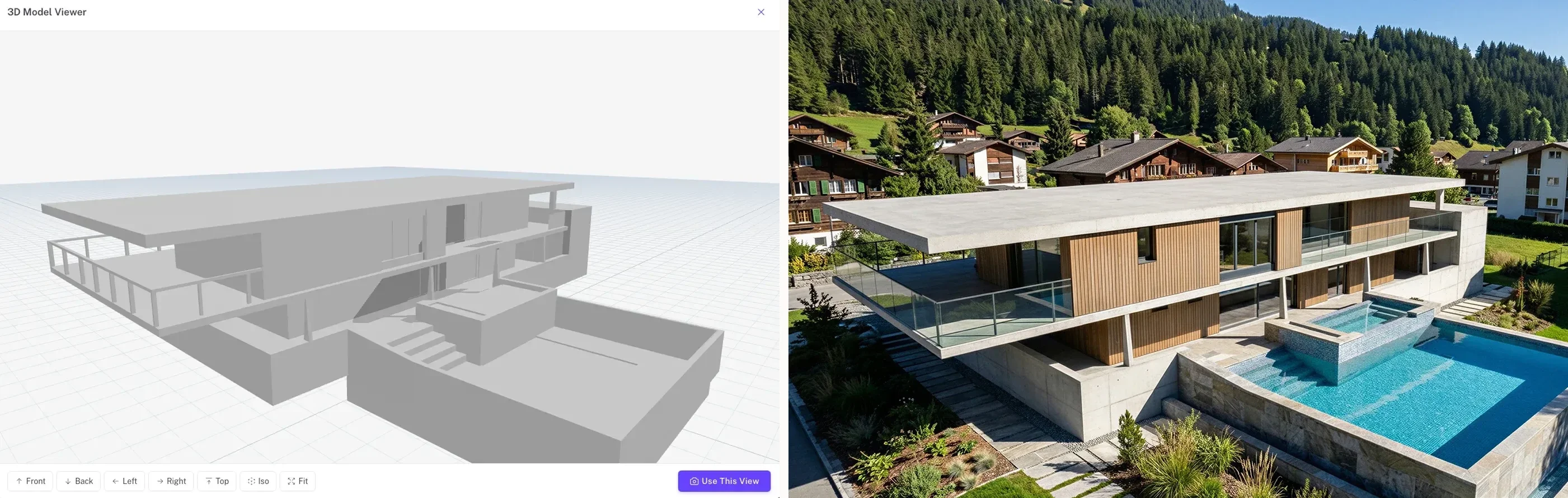
This is also where the limits are. Exact geometry does not turn a mood image into a planning document: the materials, shadows and surroundings do not come from the plans, and nobody has checked them against building codes or structural engineering. A German architecture trade magazine describes AI renders as aesthetically spectacular but not always technically plausible, and lists faulty perspectives and physically impossible shadows among the typical errors. A Swiss visualisation studio notes that prompt-only tools cannot produce exact 3D models with correct proportions or dimensions. With your own model, only the geometry comes from your file.
Revisions: included rounds or regenerate?
Studios include one to three revision rounds in the price and bill extra work by time. In the lists we read: one round at the outsourcing provider, two at a Swiss studio and at three German studios, three at the Basel studio for product images. Extra rounds cost CHF 120 per hour at the Swiss studio. An Italian studio bills a view changed after approval as a new view, and a Paris studio puts it bluntly: what blows up a quote is often not the modelling hours but the unplanned back-and-forth.
With AI there are no rounds in the contract sense. Every change is a new generation or edit at the same credit tier: ten more 2K variants cost 100 credits, which is CHF 9.80 at the Starter list price billed monthly. The flip side is that nobody but you decides whether the tenth variant is better than the third.
When should you hire a studio?
A studio is the better choice as soon as an image has to be more than a mood image. Four cases:
- The image has to match the plans. For planning applications, competitions or sales documents where floor areas and proportions must be right, you need someone who models from plans and stands behind the result. That is our assessment, not legal advice. An Austrian property trade publication points out that altering areas and proportions in listing images stays unlawful even when the image is labelled as AI: a label does not cure a misleading picture.
- Animations, fly-throughs and 360° tours. An animation starts at CHF 2,500 at the Basel studio and takes two to four weeks; a German studio lists from EUR 1,350. This comparison covers still images.
- One hero image a year, with a fixed budget and an art director signing off every detail. Craft matters more here than the number of variants, and a monthly plan does not pay off.
- There is neither a 3D model nor a photo. If the building first has to be modelled from plans, that is exactly a studio’s core work. Samsa needs a photo or a 3D model to start from.
Even an Italian AI rendering service concedes that manual rendering stays ahead for complex architectural projects, luxury properties and wherever precise 3D modelling is needed.
When is AI enough?
AI is enough when speed and volume matter more than verified dimensional accuracy. Typical cases:
- Early concept and style variants, before money goes into a final render.
- Client and stakeholder presentations: generate several style variants and put them side by side.
- Restyling a room: show a photo of an existing room in a different style.
- Product images from existing CAD files, with no physical sample needed.
- Recurring formats for social media and campaigns, when your team needs images every week.
To see how that works with your own model, go to AI 3D visualization.
3D rendering cost and time: studio or AI?
The table sums up the figures in this guide. Studio prices: Switzerland, CHF excluding VAT, as of September 2026.
| Criterion | Hire a studio | Create with AI (Samsa) |
|---|---|---|
| Price per image | typically CHF 600–1,500; from CHF 390 only under conditions | 5, 10 or 20 credits (1K, 2K, 4K); CHF 0.49–1.96 at the Starter list price |
| Time to first image | a few working days to 4 weeks | seconds to a few minutes, according to Samsa |
| Revisions | 1–3 rounds included, then e.g. CHF 120 per hour | regenerate or edit at the same credit tier |
| Geometry | modelled from plans or CAD, the studio is accountable | taken exactly from your 3D model; not guaranteed from a photo; not a planning document |
| Input | plans, CAD files, briefing | photo or 3D model (.glb, .obj, .fbx, .stl) |
| Animation, 360° | yes, animation from CHF 2,500 | not part of this comparison |
| Many variants | every extra view costs extra | variants within your credits |
| Usage rights | per contract with the studio | commercial on every plan, provided you hold the rights to your training images |
Can you combine both?
Yes, and for many projects it is the sensible route. Use AI early to find the direction: mood, material, time of day, viewpoint. Once you know which image it has to be, hire a studio for exactly that one image, with a briefing that already shows what you want. That way the studio’s revision rounds go into details instead of the basic question of direction.
3D rendering cost: frequently asked questions
How much does a 3D rendering cost?
In Switzerland, a still image from a studio typically costs CHF 600 to 1,500 excluding VAT, according to published price lists from seven Swiss providers, accessed in September 2026. The lowest entry prices, from CHF 390, can depend on an order of ten or more images, and one Zurich studio puts a high-quality exterior at up to CHF 3,500. With Samsa, an AI render costs 5 to 20 credits, CHF 0.49 to 1.96 at the Starter list price.
How long does a studio take to deliver a 3D rendering?
A few working days to four weeks. One Swiss studio plans ten to fourteen working days for one to three views, including approval of the grey model and two revision rounds. Product images are faster: a Basel studio quotes three working days. Animations take two to four weeks. With Samsa, a render usually takes seconds to a few minutes once your photo or 3D model is ready, according to its product page.
Are AI renderings true to scale?
When you upload a 3D model, Samsa keeps its geometry and your chosen camera exactly. What the model does not contain, such as surroundings or planting, is created in the render and is not checked against plans. From a photo, there is no guarantee of dimensional accuracy. For planning applications, competitions or sales documents where floor areas must be right, a studio remains the safe choice. A 1:1 demo with your own model shows what your file produces.
Do I need a 3D model for an AI rendering?
No. You can start from a photo, for example of an existing room you want to show in a different style. A 3D model gives you more control over perspective, materials and iterations, and its geometry is kept exactly. Samsa’s 3D Rendering Studio accepts .glb, .obj, .fbx and .stl files. A render costs the same as an image: 5, 10 or 20 credits, depending on the quality tier.
Can I use AI renderings commercially?
Yes, on every Samsa plan, provided you hold the rights to the images you train a model on. Every output carries C2PA Content Credentials and an imperceptible watermark. With a studio, the contract decides what you may use the images for. Ask before you commission whether web, print and marketing use are included, and get it confirmed in writing.
Sources
- Wie viel kostet eine 3D-Visualisierung in der Schweiz 2026?
- Les éléments qui influencent le prix d'une image 3d d'architecture
- Visualisierungen Preise
- 3D-Visualisierung Architektur: Preise Schweiz 2026
- Architekturvisualisierung Kosten Schweiz
- Architekturvisualisierung Schweiz
- 3D Visualisierungen Architektur: Preise, Kosten, Angebote für Architekturvisualisierungen
- Preise 3D Architektur-Visualisierungen
- Preise einer 3D Visualisierung
- Kosten und Preis einer 3D Architektur Visualisierung Made in Germany
- 3D Visualisierung Preise
- Kosten und Preise für 3D Visualisierungen
- 3D-Visualisierung: Preise und Leistungen
- Wir übersetzen Ihre Pläne in Käufersprache.
- Prix d'une image de synthèse : combien coûte un visuel 3D
- Le tarif d'une perspective 3D d'architecture
- Prix de la visualisation architecturale 3D en France
- Costo rendering 2026: prezzi aggiornati
- Listino prezzi grafica 3D
- Quanto costa un render?
- Rendering architettonico
- Rendering Immobiliare 2026: Guida Completa, Prezzi ed Esempi con AI
- Was kostet eine 3D-Produktvisualisierung bei STUDIO KALZ?
- AI im Architekturmarketing: Renderings auf Knopfdruck
- KI-Visualisierungen in der Architektur: Chancen, Grenzen – und warum Profis unersetzlich bleiben
- Wenn das Sofa nie im Zimmer stand: Wann Makler KI-Bilder im Exposé kennzeichnen müssen
From your 3D model to a render in minutes
Upload a 3D model or a photo and compare the result with your last studio quote.